
How Many Pavers for a 12×12 Patio?
Updated November 2026
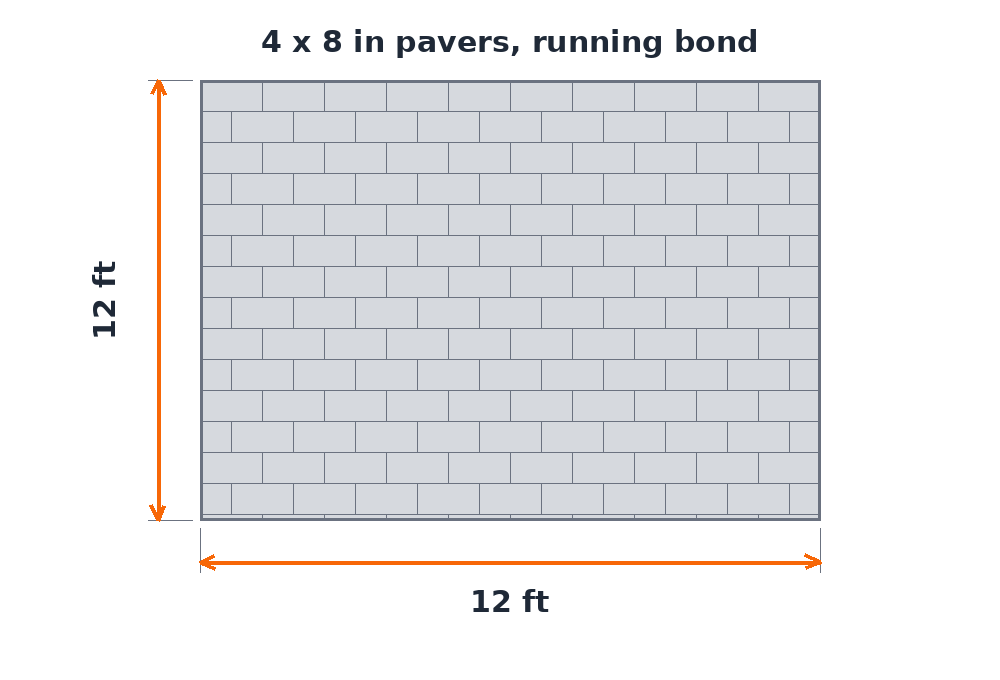
A 12×12 patio covers 144 square feet. If you are using common 4×8-inch rectangular pavers, you will need 648 pavers before waste, or 713 with 10% extra for cuts and breakage. For 12×12-inch square pavers, you will need 159 including waste.
The exact number depends on the paver size, laying pattern, joint spacing, and patio shape. This guide covers paver counts, gravel and sand quantities, installation costs, and the materials you will need to build a 12×12 patio.
For a different patio size, use our free Paver Calculator. Building the patio with bricks instead? Our Brick guide for a 10×10 patio works that job out.
Table of Contents
- Quick Answer: Materials for a 12×12 Paver Patio
- How to Calculate Pavers for a Patio
- Pavers Needed for Common Patio Sizes
- Pavers for a 12×12 Patio in Different Sizes
- Will Every Paver Size Fit Without Cutting?
- How Much Extra for Paver Cuts?
- Gravel Base and Bedding Sand
- How Many Bags of Polymeric Sand?
- How Much Slope Does a Patio Need?
- Edge Restraint and Excavation Depth
- How Many Pavers Are in a Pallet?
- How Much Does a 12×12 Paver Patio Cost?
- Common Mistakes
- Frequently Asked Questions
Quick Answer: Materials for a 12×12 Paver Patio
Here is a quick estimate for a 144-square-foot patio with a straight laying pattern.
| Material | Estimated Quantity |
|---|---|
| 4×8-inch pavers | 713 with 10% waste |
| 12×12-inch pavers | 159 with 10% waste |
| 16×16-inch pavers | 90 with 10% waste |
| Gravel base, 4 inches | 1.96 cubic yards with 10% extra |
| Gravel base, 6 inches | 2.93 cubic yards with 10% extra |
| Bedding sand, 1 inch | 0.49 cubic yards with 10% extra |
| Polymeric joint sand | Depends on joint dimensions; see below |
| Edge restraint | Up to 48 linear feet |
These are planning quantities. Paver dimensions, joints, soil conditions, and manufacturer installation requirements may change your final order.
How to Calculate Pavers for a Patio
You can calculate the number of pavers using three simple steps.
Step 1: Calculate the Patio Area
Multiply the patio length by its width. Patio area = Length × Width. For a 12×12 patio: 12 × 12 = 144 square feet.
Step 2: Calculate Pavers per Square Foot
A common rectangular paver measures 4×8 inches. First, calculate the face area of one paver: 4 × 8 = 32 square inches. There are 144 square inches in one square foot. 144 ÷ 32 = 4.5 pavers per square foot.
Step 3: Calculate the Total and Add Waste
Multiply the patio area by the number of pavers per square foot: 144 × 4.5 = 648 pavers. Now add 10% for cuts and breakage: 648 × 1.10 = 712.8. Round up to the next whole paver. Final quantity: 713 pavers.
This calculation uses nominal paver dimensions without separately accounting for joint spacing. Check the manufacturer’s stated coverage before ordering.
Paver Calculation Formula
Use this formula for any rectangular patio: Pavers needed = (Patio area ÷ Area per paver) × (1 + Waste percentage). Round up the final result to a whole paver. For irregular patios, calculate the area of each section separately, then add the results.
Pavers Needed for Common Patio Sizes
The table below uses 4×8-inch pavers and includes a 10% waste allowance.
| Patio Size | Area (sq ft) | Pavers Before Waste | Pavers to Buy |
|---|---|---|---|
| 8×8 ft | 64 | 288 | 317 |
| 10×10 ft | 100 | 450 | 495 |
| 10×12 ft | 120 | 540 | 594 |
| 12×12 ft | 144 | 648 | 713 |
| 12×16 ft | 192 | 864 | 951 |
| 15×15 ft | 225 | 1,013 | 1,115 |
| 20×20 ft | 400 | 1,800 | 1,980 |
The before-waste column rounds fractional quantities up to whole pavers. The buy column adds the 10% waste to that rounded count and rounds up again, the same way our Paver Calculator works, so the table and the calculator always agree.
For a 12×12 patio, the basic requirement is 648 rectangular pavers, but the order quantity increases to 713 when waste is included.
How Many Pavers for a 12×12 Patio in Different Sizes?
Larger pavers cover more area, so you need fewer individual pieces. All counts below are based on 144 square feet with 10% extra for cuts and breakage.
| Paver Size | Coverage per Paver | Before Waste | Pavers to Buy |
|---|---|---|---|
| 4×8 inches | 0.222 sq ft | 648 | 713 |
| 6×6 inches | 0.25 sq ft | 576 | 634 |
| 6×9 inches | 0.375 sq ft | 384 | 423 |
| 8×8 inches | 0.444 sq ft | 324 | 357 |
| 12×12 inches | 1 sq ft | 144 | 159 |
| 16×16 inches | 1.778 sq ft | 81 | 90 |
| 18×18 inches | 2.25 sq ft | 64 | 71 |
| 24×24 inches | 4 sq ft | 36 | 40 |
These calculations use the listed face dimensions. Actual product coverage can differ because of joint spacing, spacer bars, and manufacturing dimensions.
Tip: If your paver manufacturer provides a square-foot coverage figure, use that instead of estimating coverage from nominal dimensions.
Will Every Paver Size Fit a 12×12 Patio Without Cutting?
Not every paver layout requires the same amount of cutting. For example, if you ignore joint spacing and use a straight grid pattern, several square paver sizes divide evenly into a 12-foot patio.
| Paver Size | Theoretical Layout | Total Pavers |
|---|---|---|
| 12×12 inches | 12 rows × 12 columns | 144 |
| 16×16 inches | 9 rows × 9 columns | 81 |
| 18×18 inches | 8 rows × 8 columns | 64 |
| 24×24 inches | 6 rows × 6 columns | 36 |
These layouts are theoretical. Once you include the manufacturer’s recommended joints, some edge cuts or adjustments may be needed. For the most accurate layout, measure the actual paver dimensions and include the required joint width.
How Much Extra Should You Add for Paver Cuts?
Pavers may need cutting around patio edges, corners, steps, and other obstacles. The amount of waste depends on the laying pattern. For a 12×12 patio using 4×8-inch pavers, the theoretical requirement is 648 pavers.
| Laying Pattern | Suggested Extra | Pavers to Buy |
|---|---|---|
| Straight / running bond | 10% | 713 |
| Herringbone / diagonal | 15% | 746 |
| Curved or complex edges | 20% | 778 |
Straight or Running Bond
Pavers are arranged in straight rows, often with staggered joints. This pattern is relatively simple to install and typically requires fewer complicated cuts.
Herringbone Pattern
Pavers are arranged in a zigzag pattern. The design can create more edge cuts, especially around a square patio. A 15% waste allowance is a reasonable starting estimate.
Curved Patio Edges
Curved boundaries often require cutting more pavers to follow the shape. For a patio with several curves or irregular edges, consider a 20% allowance.
These percentages are planning guidelines, not fixed installation rules. A simple layout may produce less waste, while a complex design may produce more.
Gravel Base and Bedding Sand for a 12×12 Patio
A stable patio starts with proper ground preparation. A conventional sand-set paver patio generally has three main layers:
- Compacted aggregate base
- Bedding sand
- Pavers
The correct base depth depends on soil conditions, climate, drainage, and the manufacturer’s installation instructions.
How Much Gravel Do You Need?
For a 12×12 patio, the area is 144 square feet. Use this formula: Gravel volume (cu yd) = Area (sq ft) × Depth (in) ÷ 324.
For a 4-inch compacted base: 144 × 4 ÷ 324 = 1.78 cubic yards. For a 6-inch compacted base: 144 × 6 ÷ 324 = 2.67 cubic yards.
| Gravel Depth | Compacted Volume | With 10% Extra |
|---|---|---|
| 4 inches | 1.78 cu yd | 1.96 cu yd |
| 6 inches | 2.67 cu yd | 2.93 cu yd |
| 8 inches | 3.56 cu yd | 3.91 cu yd |
These are compacted-volume estimates. Adding 10% provides a planning buffer, but it does not guarantee enough loose gravel for compaction. Ask your aggregate supplier about the loose-to-compacted conversion for the material you are buying.
A 4-inch base may be suitable for some light-use patios on stable ground, while other installations require 6 inches or more. Follow the paver manufacturer’s specifications and local requirements.
Use our Gravel Calculator to estimate quantities for your chosen base depth.
How Much Bedding Sand Do You Need?
For a traditional sand-set patio, a 1-inch bedding layer is commonly used. For 144 square feet: 144 × 1 ÷ 324 = 0.44 cubic yards. Add 10% extra: 0.44 × 1.10 ≈ 0.49 cubic yards. That is approximately 12 cubic feet before extra material.
Use suitable coarse concrete bedding sand rather than fine play sand. Do not make the sand layer thicker to correct an uneven gravel base. Level and compact the base properly before placing the bedding sand.
For other dimensions, use our Sand Calculator.
How Many Bags of Polymeric Sand for a 12×12 Patio?
Polymeric sand fills the joints between pavers after installation. It contains binding additives that activate when water is applied according to the manufacturer’s directions.
The quantity depends on paver dimensions, joint width, joint depth, and product coverage. For example, Alliance Gator’s MAXX SAND technical data lists the following approximate coverage for 50 lb bags under its specified conditions.
| Joint Width | Coverage per 50 lb Bag | Bags for 144 sq ft |
|---|---|---|
| Narrow: 1/8–3/8 inch | 65–85 sq ft | 2–3 |
| Wide: 3/4–1¼ inch | 22–42 sq ft | 4–7 |
These figures apply to the manufacturer’s specified paver and joint conditions. Actual coverage may differ significantly for smaller rectangular pavers or different joint depths.
If your selected product covers 40 square feet per bag: 144 ÷ 40 = 3.6. Round up to 4 bags. Use this as an example, not a universal requirement. Always check the product’s coverage chart before buying.
Source: Alliance Gator MAXX SAND Technical Data Sheet
How Much Slope Does a 12×12 Paver Patio Need?
Proper drainage helps prevent rainwater from collecting on the patio or flowing toward your home’s foundation. A common patio slope is approximately 1/4 inch per foot, or about 2%.
For a 12-foot patio: 12 × 1/4 = 3 inches. That means the far edge of the patio would be approximately 3 inches lower than the starting edge. The slope should direct water toward an appropriate drainage area and away from buildings.
A slope around 1.5–2% is also recommended in Unilock’s patio installation guidance. Check local drainage requirements and avoid directing runoff onto neighboring properties.
Edge Restraint and Excavation Depth
Edge restraints help prevent pavers from spreading or shifting over time. They may be made from plastic, metal, concrete, or other approved edging systems.
How Much Edging Do You Need?
Calculate the patio perimeter: 2 × (12 + 12) = 48 linear feet. A 12×12 patio needs up to 48 linear feet of edge restraint if all four sides are exposed. Where a suitable fixed structure provides restraint, the required edging length may be lower.
The number of anchoring spikes depends on the restraint product and manufacturer instructions. At approximately 15-inch spacing, a continuous 48-foot run would have about 39 spike positions, but corners, joints, and separate restraint sections may require additional anchors.
How Deep Should You Dig?
Excavation depth depends on the compacted base, bedding layer, paver thickness, and desired finished elevation. For example:
| Layer | Thickness |
|---|---|
| Gravel base | 4 inches |
| Bedding sand | 1 inch |
| Pavers | 2⅜ inches |
| Total | 7⅜ inches |
For a 12×12 patio excavated to 7⅜ inches: 144 × (7.375 ÷ 12) ÷ 27 = 3.28 cubic yards of soil. This is the in-place excavation volume. Loose excavated soil may occupy more space. Actual excavation depth must also account for grading, finished surface height, and drainage requirements.
Before digging in the United States, contact 811 or your state’s utility notification service. Follow local notice requirements and have underground utilities marked before excavation.
How Many Pavers Are in a Pallet?
There is no universal number of pavers per pallet. Pallet quantities vary by manufacturer, paver size, thickness, and product line.
For example, if your selected pavers cover 100 square feet per pallet: 144 ÷ 100 = 1.44 pallets before waste. With 10% extra coverage: 158.4 ÷ 100 = 1.584 pallets. You would need two full pallets if the supplier only sells complete pallets. If individual pavers or partial pallets are available, you may be able to order closer to your required quantity.
Check the pallet label for pieces per pallet, square feet per pallet, paver dimensions, and weight per pallet. For the most accurate order, use the manufacturer’s stated coverage.
How Much Does a 12×12 Paver Patio Cost?
A 12×12 patio covers 144 square feet, so the total price depends on the material, installation method, labor, and site conditions. According to Angi’s October 2026 cost guide, professional paver patio installation commonly ranges from approximately $8 to $25 per square foot.
For a 144-square-foot patio:
| Installed Cost per Sq Ft | Total for 144 Sq Ft |
|---|---|
| $8 | $1,152 |
| $15 | $2,160 |
| $25 | $3,600 |
Most patios land somewhere inside that range. Doing the work yourself, you pay for materials only, which brings the total down a lot. These are example prices only. Prices change by area, supplier and type.
Common Mistakes
Ordering the exact count. Pavers get cut at the edges and some break. Always add the extra for your pattern.
Measuring the paver with a tape. Count with the nominal face size (4×8), not the real size with its joint share, or the count comes out wrong.
Skipping the gravel base. Sand alone will not hold a patio level for long.
Making the sand thicker to fix a bumpy base. Keep the sand at 1 inch and level the gravel base properly instead.
Forgetting the joints. Joint sand is a separate, smaller amount. Work it out on its own.
Your Size Is Different?
🧮 Use the Paver Calculator: Type any patio size and paver size and get the count, base and sand in seconds. The Square Feet Calculator works out the area of an odd-shaped yard.
Frequently Asked Questions
How many pavers do I need for a 12×12 patio?
You need 648 pavers of the standard 4×8 inch size. Buy 713 for a straight pattern with 10% extra for cuts and breakage.
How many 12×12 pavers do I need for a 12×12 patio?
You need 144 pavers, because each 12×12 inch paver covers exactly 1 square foot. Buy 159 with 10% extra.
How many 16×16 pavers do I need for a 12×12 patio?
You need 81 pavers. Buy 90 with 10% extra for cuts.
How much gravel base do I need for a 12×12 patio?
At 4 inches deep, you need 1.78 cubic yards, or 1.96 with 10% extra. At 6 inches deep, you need 2.67 cubic yards, or 2.93 with the extra.
How much sand goes under pavers for a 12×12 patio?
You need 0.44 cubic yards of bedding sand for a 1 inch layer, or 0.49 with 10% extra.
How many bags of polymeric sand for a 12×12 patio?
It depends on the joint width. For 50 lb bags, allow about 2 to 3 bags for narrow joints and 4 to 7 bags for wide joints. At a cautious 40 square feet per bag, the count is 4 bags. Check your product’s coverage chart before buying.
How many pavers are in a pallet?
There is no single count. It changes with the maker, paver size and product line. Check the pallet tag for pieces per pallet and square feet per pallet. If a pallet covers 100 square feet, a 12×12 patio needs 1.44 pallets before waste, so two pallets if only full pallets are sold.
How much slope does a paver patio need?
About 1/4 inch per foot, roughly 2%. Across a 12 foot patio, the far edge sits about 3 inches lower than the starting edge, so water runs away from the house.
How much does a 12×12 paver patio cost?
Professional installation runs about $8 to $25 per square foot (Angi, October 2026), so a 144 square foot patio comes to roughly $1,150 to $3,600 installed. Doing it yourself, you pay for materials only. These are example prices only. Prices change by area, supplier and type.
Do I need edge restraint for a paver patio?
Yes, on every open edge. A 12×12 patio needs up to 48 linear feet of edging and about 39 spikes at 15 inch spacing.
Please note: Results are planning estimates. Check your paver and bag labels before you order, and confirm big orders with your supplier.