
Raised Bed Soil Calculator
Free calculator with worked examples, a mix guide and a common sizes table. Last updated October 2026.
This raised bed soil calculator works out how much soil a bed needs and splits it into topsoil and compost. Enter the bed size and the fill depth, keep the usual 70/30 mix or choose your own, and get cubic yards and bags for each material. It is free, with no sign-up.
Table of Contents
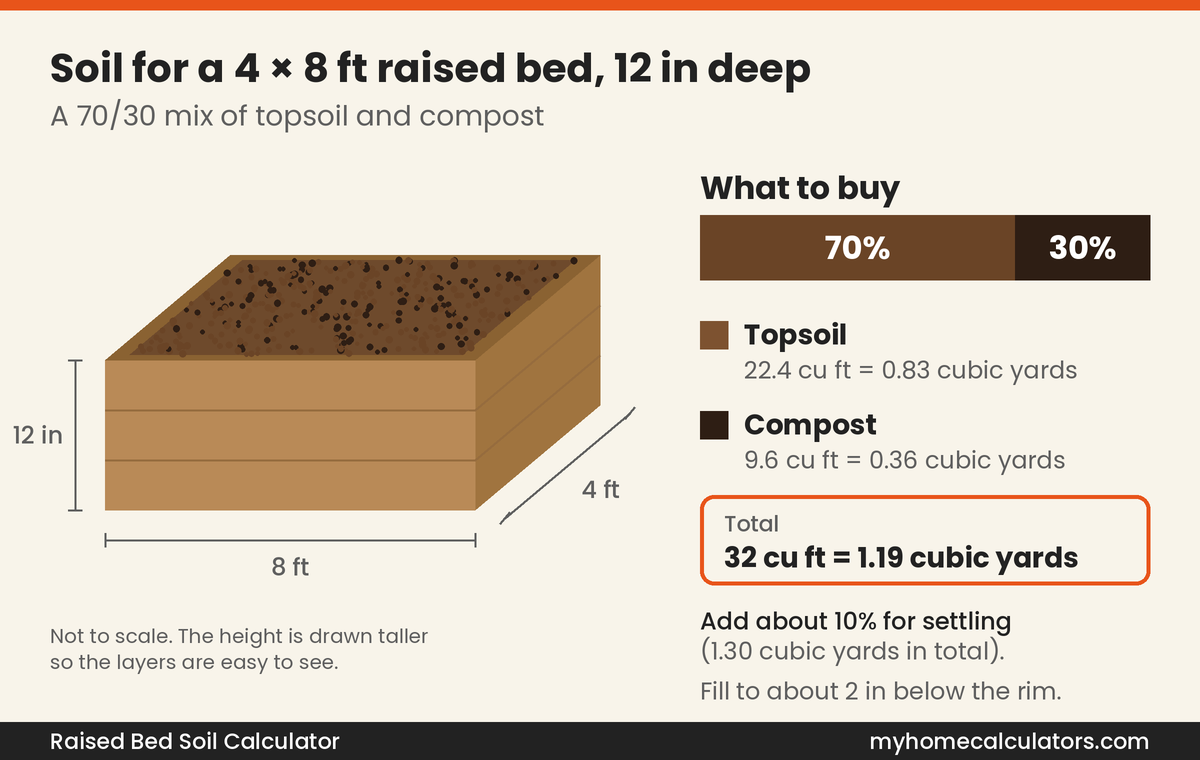
Fill to about 2 in below the rim.
The three percentages must add up to 100%. Set the third material to 0 if you do not need it.
How We Calculate
Volume of one bed. Rectangle: length × width × depth in feet (inches ÷ 12). A 4 × 8 ft bed at 12 in is 4 × 8 × 1 = 32 cubic feet. Round bed: 3.1416 × radius × radius × depth.
Number of beds. Multiply by the number of identical beds.
Add the extra for settling. At 10%, 32 cubic feet becomes 35.2.
Split by the mix. Each material is the total times its share. At 70/30 the 32 cubic feet is 22.4 cubic feet of topsoil and 9.6 of compost (or 24.64 and 10.56 with the extra).
Cubic yards = cubic feet ÷ 27. 22.4 ÷ 27 = 0.83 and 9.6 ÷ 27 = 0.36.
Bags = the material’s cubic feet ÷ bag size, rounded up, for each material on its own. 22.4 ÷ 1.5 = 14.93, so 15 bags of topsoil. 9.6 ÷ 1.5 = 6.4, so 7 bags of compost.
The percentages must add up to 100%. Rounding happens only at the end. Cost uses the rounded cubic yards (or whole bags) shown in the result.
Choosing the Mix
There is no single recipe, and guides do not agree. Many extension services give about 70% soil to 30% compost as a starting point. Penn State Extension recommends that ratio for raised beds and says to use good-quality soil and compost from reputable sources. Iowa State Extension lists equal parts topsoil, organic matter and coarse sand as its first mix, and about 70% topsoil with 30% compost as another option. Other guides use 60/30/10 with a drainage material, or Mel’s Mix, which is a different recipe built from compost, peat or coir, and vermiculite. This calculator starts at 70/30 and lets you change it.
| Mix | Topsoil | Compost | Third material | Notes |
|---|---|---|---|---|
| 70/30 (default) | 70% | 30% | None | A common starting point |
| 50/50 | 50% | 50% | None | Richer, uses more compost |
| 60/30/10 | 60% | 30% | 10% (sand, perlite) | Adds drainage if topsoil is heavy |
| Equal thirds | About a third | About a third | About a third (coarse sand) | One Iowa State option |
For a 4 × 8 ft bed filled 12 in (32 cubic feet, no extra):
| Mix | Topsoil | Compost | Third material |
|---|---|---|---|
| 70/30 | 0.83 yd³ | 0.36 yd³ | None |
| 50/50 | 0.59 yd³ | 0.59 yd³ | None |
| 60/30/10 | 0.71 yd³ | 0.36 yd³ | 0.12 yd³ |
Your own soil and plants matter. A soil test tells you more than any ratio, and the maker of your compost may suggest a mix.
Common Bed Sizes
12 in deep, 70/30, no extra:
| Bed | Total | Topsoil | Compost |
|---|---|---|---|
| 3 × 6 ft | 18 cu ft = 0.67 yd³ | 0.47 yd³ | 0.20 yd³ |
| 4 × 4 ft | 16 cu ft = 0.59 yd³ | 0.41 yd³ | 0.18 yd³ |
| 4 × 8 ft | 32 cu ft = 1.19 yd³ | 0.83 yd³ | 0.36 yd³ |
| 4 × 12 ft | 48 cu ft = 1.78 yd³ | 1.24 yd³ | 0.53 yd³ |
The same 4 × 8 ft bed at other depths:
| Depth | Total | Topsoil (70%) | Compost (30%) |
|---|---|---|---|
| 6 in | 16 cu ft = 0.59 yd³ | 0.41 yd³ | 0.18 yd³ |
| 8 in | 21.33 cu ft = 0.79 yd³ | 0.55 yd³ | 0.24 yd³ |
| 10 in | 26.67 cu ft = 0.99 yd³ | 0.69 yd³ | 0.30 yd³ |
| 12 in | 32 cu ft = 1.19 yd³ | 0.83 yd³ | 0.36 yd³ |
| 18 in | 48 cu ft = 1.78 yd³ | 1.24 yd³ | 0.53 yd³ |
Worked Examples
One bed, 70/30: 4 × 8 ft, 12 in, no extra. 32 cu ft, which is 1.19 yd³: 0.83 yd³ topsoil and 0.36 yd³ compost. In 1.5 cu ft bags that is 15 bags of topsoil and 7 of compost.
With 10% for settling: 35.2 cu ft, which is 1.30 yd³: 0.91 yd³ topsoil and 0.39 yd³ compost. In 1.5 cu ft bags that is 17 and 8. In 0.75 cu ft bags it is 33 and 15.
Two beds: two 4 × 8 ft beds, 12 in deep, are 64 cu ft, or 2.37 yd³. At 70/30 that is 1.66 yd³ topsoil and 0.71 yd³ compost. With 10% extra the total is 70.4 cu ft, or 2.61 yd³.
A round bed: 6 ft across, 12 in deep. The area is 28.27 sq ft, so 28.27 cu ft, or 1.05 yd³: 0.73 yd³ topsoil and 0.31 yd³ compost.
A cheaper blend with drainage: the 4 × 8 ft bed at 60/30/10 takes 19.2 cu ft of topsoil, 9.6 of compost and 3.2 of sand, which is 0.71, 0.36 and 0.12 yd³.
Metric: a 1.2 × 2.4 m bed, 0.3 m deep, is 0.864 m³ (about 1.13 yd³). At 70/30 that is 0.605 m³ of topsoil and 0.259 m³ of compost.
Bags or Bulk?
A 4 × 8 ft bed takes 1.19 cubic yards, which is about 22 bags of 1.5 cu ft, so bags suit a small bed or two. One cubic yard is 18 bags of 1.5 cu ft, or 36 bags of 0.75 cu ft, so bagging a big job takes many trips and usually costs more per yard. Bulk topsoil and compost come loose in a truck and are tipped on the driveway, which suits several beds. Ask a yard if it sells a ready blend, and what ratio it is. The bag count is by volume, so check the cubic feet printed on the bag.
Filling the Bed
Take off any grass and loosen the soil underneath, then add the new mix a few inches at a time and work each layer into the one below, so there is no sharp line between two kinds of soil. Iowa State advises this to keep water and roots moving.
Choose screened topsoil. Unscreened soil can bring in weed seeds.
Use finished compost that is mature and not too salty.
Fill to about 2 in below the rim. The bed settles after watering, so top it up later.
For a vegetable bed, ask where the soil comes from.
Common Mistakes
Filling with topsoil alone, or compost alone. Topsoil on its own can pack hard; compost on its own can settle fast. Most guides use a blend.
Rounding the bags together. Round topsoil bags and compost bags on their own, then add them.
No extra for settling. The bed drops after the first waterings.
Layering instead of mixing. Distinct layers can block water and roots.
Filling right to the rim. The first heavy watering washes soil over the edge.
Mixing cubic feet and cubic yards. One cubic yard is 27 cubic feet, not 3.
Ignoring the compost quality. Fresh, unfinished compost can harm young plants.
Frequently Asked Questions
How much soil do I need for a raised bed?
Multiply length × width × depth in feet to get cubic feet, then divide by 27 for cubic yards. A 4 × 8 ft bed filled 12 in deep takes 32 cubic feet, or 1.19 cubic yards, plus about 10% for settling.
What is the best soil mix for a raised bed?
There is no single best mix. About 70% topsoil and 30% compost is a common starting point (Penn State Extension). Iowa State also lists equal parts topsoil, organic matter and coarse sand, and other guides use 60/30/10 or Mel’s Mix.
How much topsoil and compost for a 4 × 8 raised bed?
At 70/30 and 12 in deep, about 0.83 cubic yards of topsoil and 0.36 cubic yards of compost (0.91 and 0.39 with 10% extra).
How many bags of soil for a 4 × 8 raised bed?
In 1.5 cu ft bags at 70/30: 15 bags of topsoil and 7 of compost, or 17 and 8 with 10% extra. Check the volume on your bag.
How many cubic feet are in a cubic yard?
27.
How deep should a raised bed be?
It depends on the plants. This calculator takes any depth, and the table above shows a 4 × 8 ft bed from 6 to 18 in.
How much soil for a 4 × 4 raised bed?
At 12 in deep, 16 cubic feet, or 0.59 cubic yards: 0.41 yd³ topsoil and 0.18 yd³ compost at 70/30.
Does the soil settle?
Yes. Fill to about 2 in below the rim, add about 10% for settling, and top the bed up as it drops.
Can I use only topsoil or only compost?
Most guides use a blend, because each alone has problems. Ask your local extension office for advice for your plants and soil.
Should I buy bagged soil or bulk?
Bags suit a small bed or two. For several beds, bulk by the cubic yard is usually the practical route.
Do I need sand or perlite?
Some mixes add a drainage material, especially if the topsoil is heavy. You can add it in the optional third field.
How many cubic feet is a 40 lb bag of potting soil?
It depends on the bag. Weight does not convert to volume by a fixed number, because the density of potting soil varies. Check the cubic feet printed on the bag, and use that volume. That is why this calculator works by volume, not weight.
Sources
Penn State Extension, “Soil Health in Raised Beds”: extension.psu.edu/soil-health-in-raised-beds
Iowa State University Extension, “What would be a good soil mix for a raised bed?”: yardandgarden.extension.iastate.edu/faq/what-would-be-good-soil-mix-raised-bed
Soil quantities on this page are planning estimates. Confirm bag sizes from the label and the blend with your supplier.